CRJ 20:4 is live now!
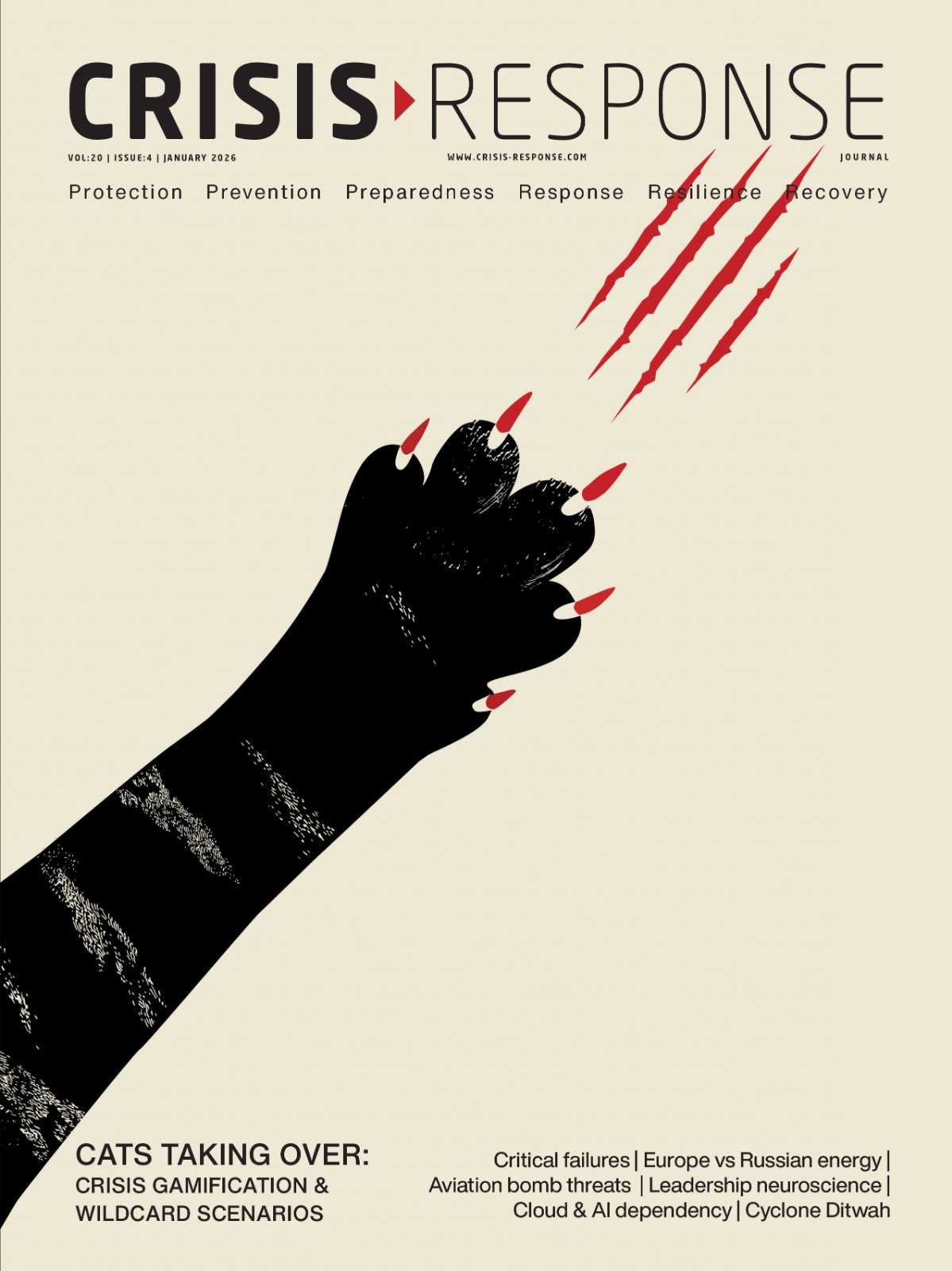 CRJ 20:4 is live now. The digital edition can be accessed here, whereas CRJ 20:4 hard copies will be mailed out shortly.
This edition tackles the theme of energy woes, examining how blackouts, grid fragility, and geopolitical dependencies test the resilience of European and global energy networks. It also covers cloud failures, emerging security risks, crisis leadership, and resilience strategies, highlighting innovative tools, technology, and community-driven solutions to prepare for and respond to crises.
Comment: Matthew Porcelli explores how passivity, poor maintenance, and inadequate training can trigger major crises, looking at the 2003 Northeastern blackout in the USA and Canada.
Onto energy woes: Dlzar Al Kez explains why the European supergrid’s level of interconnectedness can create fragility and instability across borders. Shixiang Zhu highlights predictive analysis as a solution to protect grid networks from extreme weather events, while Kristian Ruby asks, 'How can Europe create resilient and modern energy networks in an age of cyber threats?'
Dlzar Al Kez writes: "The most chilling aspect of the Spring 2025 events was not the darkness itself, but the cascading failure of societal systems that rely on the grid" (p16)
Kunwar Khuldune Shahid examines Europe’s struggle to break its dependence on Russian energy. He asks: “If a Ukraine peace plan were to be agreed in the near future, how would Russia feature in the European energy mix going forward, especially given that the cost-efficient energy infrastructure remains available to seek reintegration?”
On the other hand, Zainab Farooqui contrasts European and South Asian responses to outages in 2025, examining how what is a crisis event in one region is business as usual in another.
This edition also looks at growing global dependency on cloud systems, and AI – and why we must take the warning signs more seriously. Rodney Thayer explains how the growing scale and complexity of the Internet make widespread cloud outages inevitable.
Meanwhile, Cedrick Moriggi reflects on how recent cloud failures affect businesses. He says: “Everyone is in the same situation. Consider this: when AWS is down, your coffee maker will not give you a cup. Your coffee maker, sitting in your kitchen with your pods and water, needs permission from a server in California, USA, to work.”
In an era of emerging risks, Sandra Galletti and Massimo Pani examine insider threats that come with remote work and global hiring, urging leaders to adopt a ‘Zero Assumption’ cross-functional approach.
Remote work and global hiring have reshaped how organisations build their teams and determine who gains access to their systems, say Sandra Galletti and Massimo Pani (p38)
On the AI front: Mostafa Sayyadi, Michael Provitera and Majid Ghazizadeh propose a framework to guide crisis leadership in the post-AI world. Raphaël de Vittoris explores how leaders must adopt a glocal model, combining local autonomy with global coherence.
Sean Cunningham examines it as a possible crisis management solution and asks whether AI-enabled logkeeping could fill critical gaps or if it will introduce new risks.
Vidhi Sharma reviews her research on young adults and their complicated emotional relationships with AI. She writes that many did not process AI as technology: “They saw themselves as simply talking, reflecting or unloading. The tool’s neutrality made them feel safe, yet that very neutrality also created blind spots.”
On transport security: Amanda Coleman examines the British Transport Police’s ‘See it. Say it. Sorted.’ slogan, calling for clearer communication and detailed security measures for rail travel. For aviation, Andy Blackwell addresses the issue of bomb threats and security responses to them, while Inderjit Singh urges authorities to adopt a ‘prevention is better than cure’ stance.
This issue also includes several pieces taking on different aspects of mapping crises and improving response: Evangeline Inniss-Springer, Stacy-Ann Austin and Philomena Robertson look at how geospatial data can be used to inform interventions for reducing disaster risk, while Atiya Anis and Mariana Marín examine OpenStreetMap and its use by the Humanitarian OpenStreetMap Team in disaster response. Chad Council, Margaret McGuinness and Nathaniel Hanson explore Sprout, a soft search and rescue robot.
Luavut Zahid reports on the community's response to Cyclone Ditwah in Sri Lanka, while Marcio Curvello explains how photojournalism in crisis situations captures human suffering, mobilises action, and preserves collective memory.
Nadir Abu-Samra Spencer and Clodoaldo Castiano highlight a new tool to aid people with disabilities and elderly individuals in crisis situations, while Andrew B Brown looks at how humanitarian work must be transformed through local empowerment, collaboration, and proactive risk management.
Alice Rowan notes that despite repeated scandals and pledges of reform, systemic exploitation persists in industries from fast fashion to green energy.
Resilience is a shifting, living thing with many moving parts. Stephen Arundell and David McClory address a paradox: while London, UK’s, resilience workforce numbers rise, growth remains low. Echoing this, Richard Fitzhugh argues that resilience measurement should focus on improvement, not mere reporting.
Jeannie Barr analyses the effects of eroding trust in systems, leading to chaotic fallouts for emergency planning and resilience. Amanda Coleman crisis simulation exercises must evolve to test communication under pressure to address the world’s permacrisis state.
How an organisation communicates essential information in the early stages of an incident can determine whether people take necessary action to stay safe, notes Amanda Coleman (p60)
Gianluca Pescaroli and Femke Mulder present a stress-testing approach for high-impact, low-probability events using a card-based scenario game. Similarly, Andy Marshall explores the gamification of organisational resilience. He adds: “The antidote to military complexity and uncertainty has been preparation. Why, then, would war’s close relation, business, not ask whether gamification, and specifically wargaming, is something it too should consider? If the cap fits, why not wear it?”
Frontline: Zainab Farooqui speaks to Clifford Stott on his new policing approach to crowd management, drawn from theories of crowd psychology. He explains: “What we understand is that crowd behaviour, especially collective behaviour, is driven by a psychological construct, and what we help to do is change how the police think about crowds strategically.”
Meanwhile, Ashley Douglas offers a new approach to leadership as she applies a neuroscience lens. Her article debunks a common myth: to succeed, leaders must think harder, focus more, and simply push through under pressure.
The A-PAD International Symposium wrapped up on November 25, 2025, in Colombo, Sri Lanka, focusing on collaboration, resilience, and mitigation, Zainab Farooqui reports.
Robert Hall’s new book, The Resilience Mindset: A Philosophical Journey, traces the history of philosophy and how it resonates with the modern concept of resilience.
The Crisis Response Journal is available to subscribers only – we have a range of subscription rates to suit all needs. Click here for more details, or contact us at hello@crisis-response.com – we would love to hear from you!
Read CRJ 20:4 here.